15 Easy Cutting Activities for Kindergarten | Scissor Practice
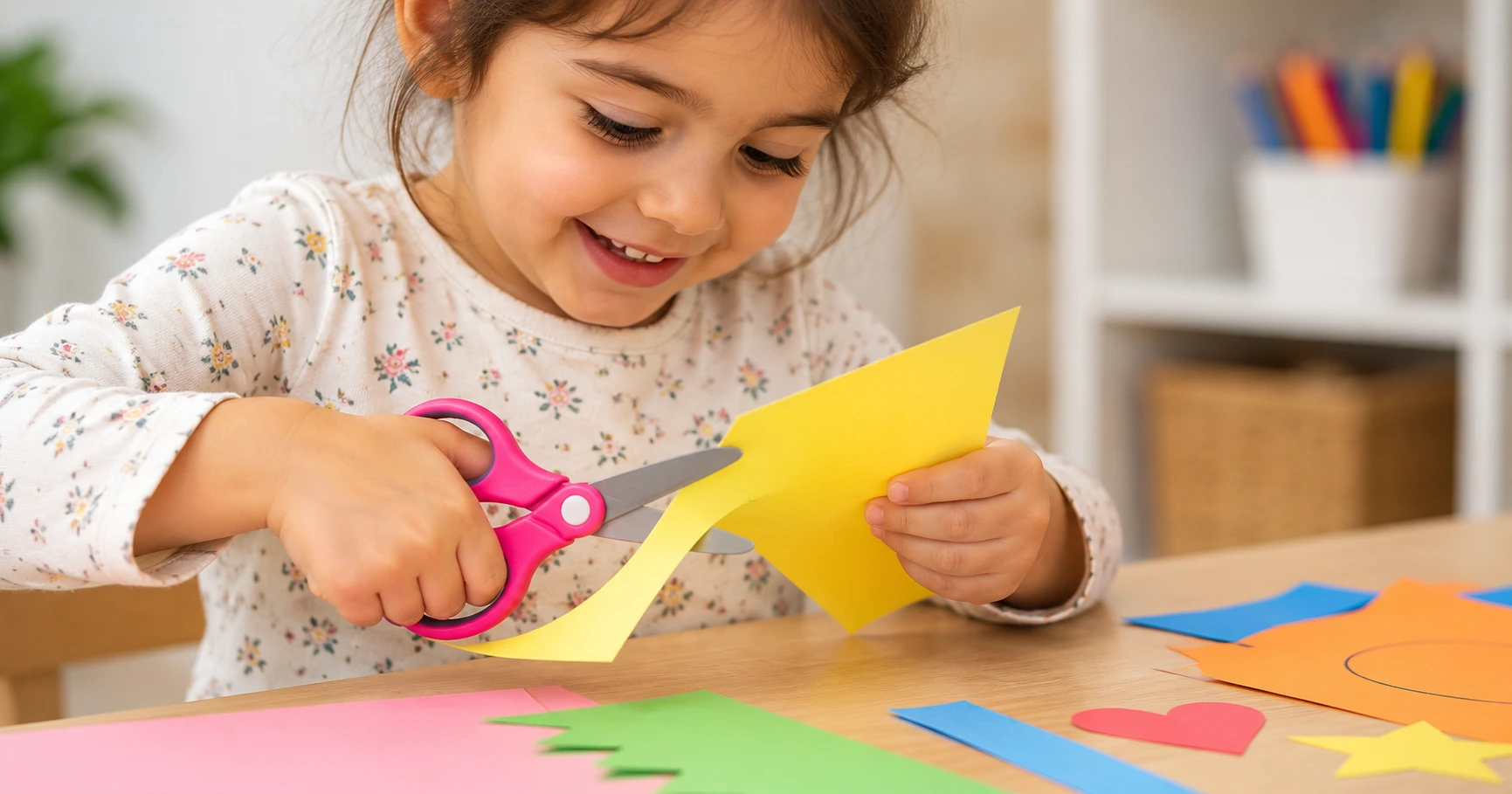
Learning to use scissors takes practice, but that practice does not need to come from a thick stack of worksheets.
For these cutting activities, you only need a few simple materials and a little space at the table. Your child can practice snipping, following lines, and cutting simple shapes at their own pace.
Start with short, simple cutting activities and let your child move on when they feel ready. The goal is not perfect cutting—it is simply to give them relaxed opportunities to practice using scissors safely and comfortably.
These 15 cutting activities for kindergarten are simple, low-prep ideas you can use at home with paper, child-safe scissors, and a few everyday materials.
Table of Contents
Quick Activity Overview
- Time: 5–10 minutes
- Prep: Low
- You’ll need: Paper, child-safe scissors, crayons or markers, and a few simple household materials
- Focus: Snipping, following lines, turning the paper, and cutting simple shapes
- Best for: Simple scissor practice at home for kindergarten-age children
Why Cutting Practice Matters
Cutting with scissors gives children opportunities to practice small, controlled hand movements while using both hands together. One hand guides the scissors while the other helps hold and turn the paper.
These movements can support the hand control children use in everyday tasks such as drawing, writing, dressing, and handling small objects.
Keep the practice short and relaxed. Children do not need to cut perfectly; they simply need repeated chances to open and close the scissors, follow a path, and adjust the paper as they work.
15 Easy Cutting Activities for Kindergarten
1. Snip Short Paper Strips
Cut a few strips of paper and invite your child to make small snips along the edge using child-safe scissors.
Start with short strips that are easy to hold. If your child is comfortable, make the strips a little longer or draw simple marks to show where to cut.
You’ll need: Paper strips, a marker, and child-safe scissors
2. Cut Along Straight Lines
Draw a few short straight lines on a piece of paper and invite your child to cut along each line slowly.
Start with thick, dark lines that are easy to see. As your child becomes more comfortable, you can make the lines a little longer or narrower.
You’ll need: Paper, a marker, and child-safe scissors
3. Cut Along Curved Lines
Draw a few gentle curved lines on a piece of paper and invite your child to follow the curves with the scissors.
Keep the curves wide and simple at first. If needed, show your child how to turn the paper slowly while keeping the scissors pointed forward.
You’ll need: Paper, a marker, and child-safe scissors
4. Cut Zigzag Lines
Draw a few wide zigzag lines on a piece of paper and invite your child to cut along the path one section at a time.
Encourage your child to pause at each corner, turn the paper, and continue cutting. Start with large zigzags before trying smaller ones.
You’ll need: Paper, a marker, and child-safe scissors
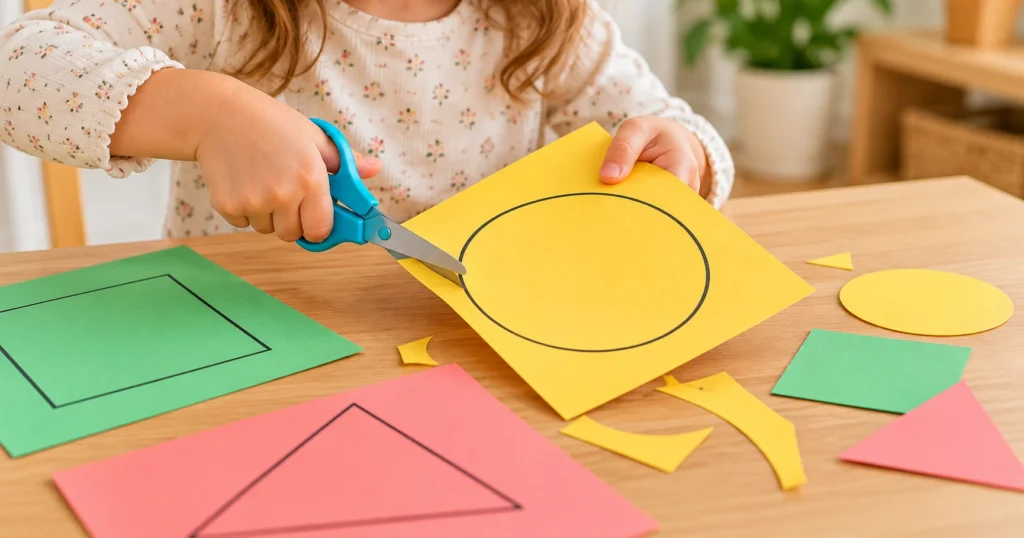
5. Cut Around Large Shapes
Draw a large circle, square, or triangle on a piece of paper and invite your child to cut around the outside of the shape.
Start with large shapes and thick outlines so there is plenty of space to guide the scissors. Remind your child to turn the paper as needed instead of twisting their wrist.
You’ll need: Paper, a marker, and child-safe scissors
6. Cut Fringe Around Paper
Give your child a strip or rectangle of paper and invite them to make short cuts along one edge to create a simple fringe.
Draw small guide marks if that helps. Encourage your child to stop before cutting all the way through the paper.
You’ll need: Paper, a marker if needed, and child-safe scissors
7. Cut Simple Picture Strips
Draw or print a few simple pictures in a row, then cut the paper into strips so each strip has one picture or shape.
Invite your child to cut between the pictures along short guide lines. Keep plenty of space between each picture so the cuts feel manageable.
You’ll need: Paper with simple pictures or shapes, a marker or printer, and child-safe scissors
8. Cut Around Stickers
Place a few large stickers on a sheet of paper, leaving plenty of space around each one.
Invite your child to cut around the outside of each sticker. Start with large stickers and simple shapes so the cutting path is easy to follow.
You’ll need: Large stickers, paper, and child-safe scissors
9. Cut Paper Into Small Squares
Draw several simple lines across a strip of paper to divide it into small sections. Invite your child to cut along the lines to make small paper squares.
Start with wide sections that only need one simple cut at a time. As your child becomes more comfortable, you can make the sections a little narrower.
You’ll need: Paper, a marker, and child-safe scissors
10. Cut Play Dough With Scissors
Roll play dough into short logs or flatten it into a thick sheet, then invite your child to make simple snips with child-safe scissors.
Because play dough is soft and easy to cut, it can be a simple way to practice opening and closing the scissors before moving on to paper.
You’ll need: Play dough and child-safe scissors
11. Cut Around Magazine Pictures
Choose a few large, simple pictures from an old magazine or catalog and invite your child to cut around them.
Start with pictures that have clear outlines and plenty of space around the edges. If needed, trim the page first so it is easier for your child to hold and turn.
You’ll need: An old magazine or catalog and child-safe scissors
12. Cut Out Simple Coupons
Draw a few large rectangles on a sheet of paper and pretend they are simple coupons or tickets.
Invite your child to cut along the straight lines to separate each one. You can add simple drawings, numbers, or colors to make the activity more playful.
You’ll need: Paper, a marker or crayons, and child-safe scissors
13. Cut Simple Paper Paths
Draw a wide path across a sheet of paper using two simple lines, then invite your child to cut through the middle of the path.
Start with a straight path, then try gentle curves if your child is comfortable. Keep the path wide enough so there is plenty of room to guide the scissors.
You’ll need: Paper, a marker, and child-safe scissors
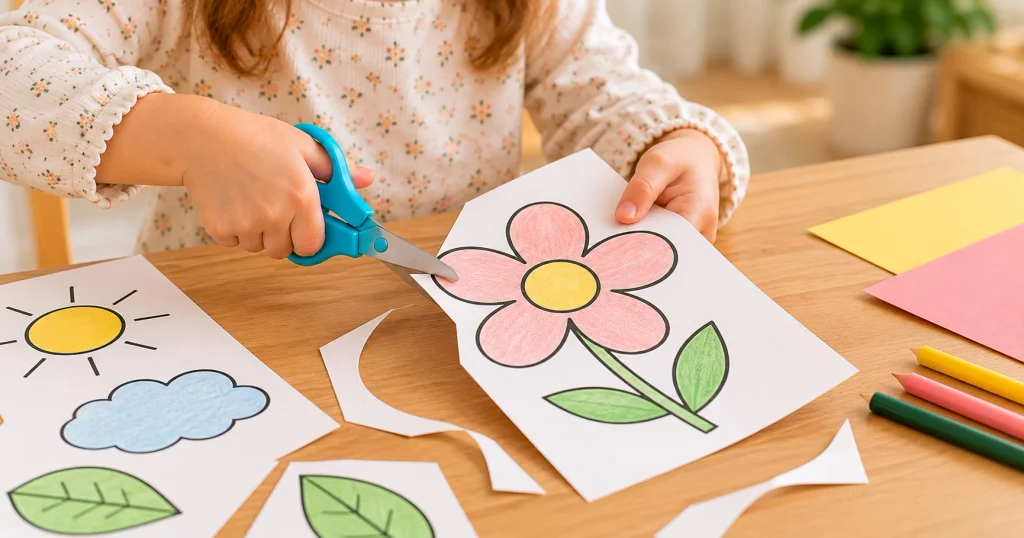
14. Cut Around Simple Drawings
Draw a few simple objects on paper, such as a sun, cloud, flower, or leaf, and invite your child to cut around the outside of each drawing.
Choose large drawings with clear outlines and plenty of space around them. If the shape feels too difficult, make the outline thicker or simplify the drawing.
You’ll need: Paper, a marker or crayons, and child-safe scissors
15. Cut and Sort Simple Shapes
Draw or cut out a few large simple shapes, such as circles, squares, and triangles, and invite your child to cut around them before sorting the finished pieces.
Keep the shapes large and easy to handle. After cutting, your child can group them by shape, color, or size for a simple extra activity.
You’ll need: Paper, a marker or crayons, and child-safe scissors
How to Make Cutting Practice Easier or More Challenging
Every child will find some cutting activities easier than others, so it can help to adjust the task instead of expecting the same level each time.
To make an activity easier, try using shorter cutting lines, thicker outlines, larger shapes, or smaller pieces of paper that are easier to hold and turn.
To make an activity more challenging, try longer paths, narrower lines, smaller shapes, or gentle curves that require a little more control.
If your child becomes frustrated or tired, it is fine to stop and try again another day. Short, relaxed practice is more useful than turning the activity into a struggle.
Busy Parent Tips for Scissor Practice at Home
You do not need to plan a long cutting session. Choose one of these cutting activities for kindergarten and keep it short—five or ten minutes can be enough, especially when your child is still getting comfortable with scissors.
Keep the basic materials together in one small container, such as paper, markers, and child-safe scissors, so you can set up a quick cutting activity without searching for supplies.
You can also reuse the same simple materials in different ways. A sheet of paper can become straight-line practice one day, shape cutting the next, or a simple picture-cutting activity later in the week.
Safety Tips for Cutting Activities
Choose child-safe scissors that are appropriate for your child, and supervise them closely while they are cutting.
Use scissors only for cutting activities, and remind your child to keep the blades pointed away from their body and fingers.
Teach your child to carry scissors with the blades closed and pointed downward, while holding the handles securely. Keep scissors stored safely out of reach when the activity is finished.
Frequently Asked Questions
What are good cutting activities for kindergarten?
Simple activities such as snipping paper strips, cutting along straight or curved lines, cutting around large shapes, and using play dough can all give kindergarten-age children opportunities to practice using scissors.
How can I make cutting practice easier for my child?
Start with short cutting lines, thick outlines, and larger pieces of paper that are easy to hold. You can also choose softer materials, such as play dough, before moving on to more detailed paper cutting.
How often should kindergarten children practice cutting?
There is no strict schedule you need to follow. Offer short opportunities to practice when your child is interested and comfortable, and stop if they become tired or frustrated.
A Simple Place to Start
These cutting activities for kindergarten do not need to be complicated. Start with one simple activity, keep the materials easy to manage, and let your child practice at their own pace.
A few minutes of snipping, following lines, or cutting simple shapes can give your child useful practice without turning the activity into a long lesson.
Sources & Further Reading
National Association for the Education of Young Children (NAEYC) — Help Your Child Build Fine Motor Skills
https://www.naeyc.org/node/948
American Academy of Pediatrics — Hand and Finger Skills of Your Preschooler
https://www.healthychildren.org/English/ages-stages/preschool/Pages/hand-and-finger-skills-of-your-preschooler.aspx
National Association for the Education of Young Children (NAEYC) — Preschool Play Plans: Playdough
https://www.naeyc.org/resources/pubs/tyc/oct2018/preschool-play-plan-playdough