Fine Motor Activities for Kindergarten at Home
Fine motor activities for kindergarten do not have to require worksheets, special supplies, or a long setup. Simple everyday activities can give children opportunities to practice using their hands and fingers while they play, build, draw, cut, pour, and help with familiar tasks at home.
The 15 ideas below are designed for busy parents and use mostly simple materials you may already have. Most can be set up in just a few minutes, so you can choose one activity, keep it relaxed, and let your child practice at their own pace.
Table of Contents
Quick Activity Overview
- Time: 5–10 minutes
- Prep: Low
- Materials: Simple household or inexpensive items
- Focus: Hand and finger control, grasping, pinching, cutting, building, and coordination
- Best for: Simple fine motor practice at home for kindergarten-age children
What Are Fine Motor Skills in Kindergarten?
Fine motor skills involve the small, controlled movements of the hands and fingers. Kindergarten-age children use these skills during everyday tasks such as drawing, writing, cutting with scissors, building with blocks, completing puzzles, opening containers, using utensils, and fastening buttons or zippers.
At home, fine motor practice does not need to feel like a lesson. Simple play and everyday routines can give children many natural opportunities to use their hands and fingers in different ways.
15 Easy Fine Motor Activities for Kindergarten
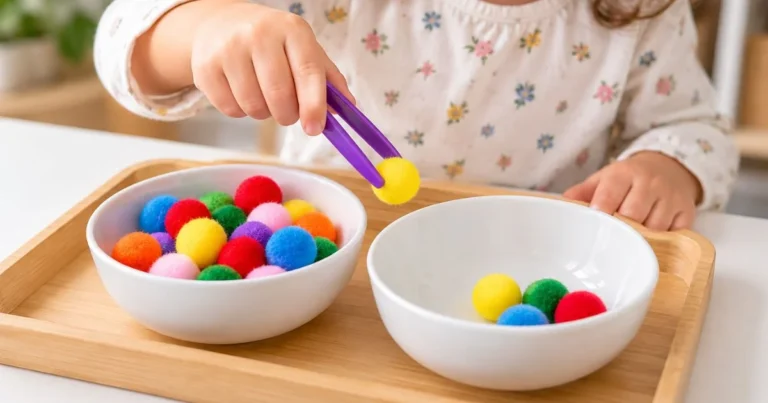
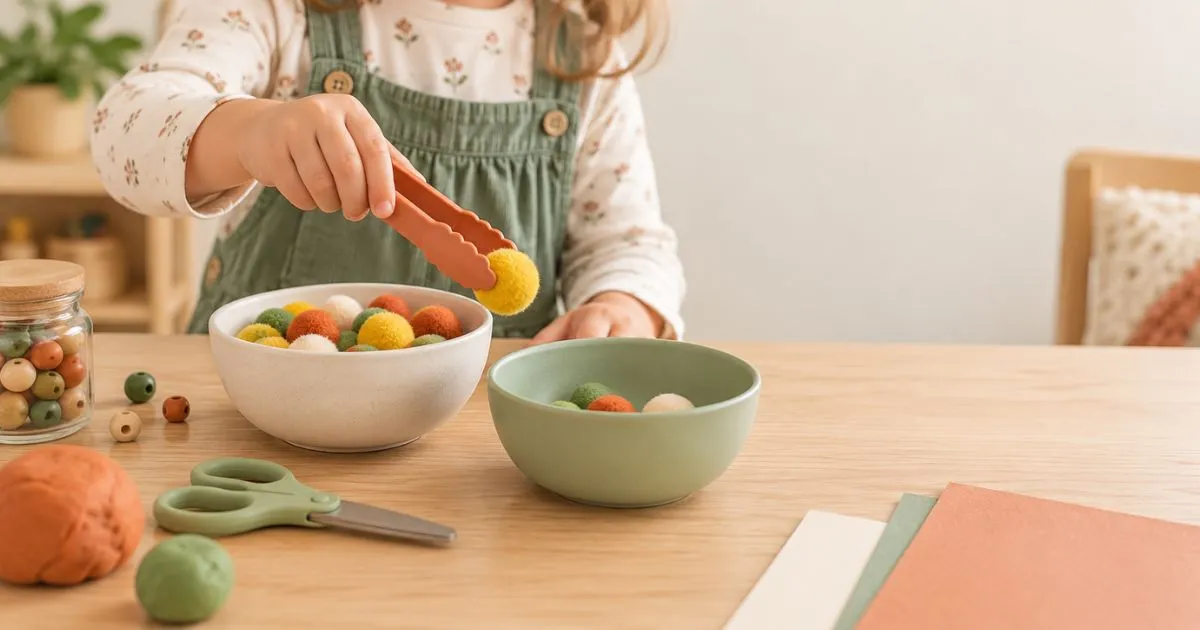
1. Pom-Pom Transfer With Tongs
Place a small bowl of pom-poms beside an empty bowl and invite your child to move the pom-poms one at a time using child-friendly tongs or tweezers. For a full step-by-step version, try our 5-minute pom-pom fine motor activity.
This simple activity gives children practice with squeezing, grasping, and hand-eye coordination.
To make it easier, use larger pom-poms or kitchen tongs. To add a little challenge, invite your child to sort the pom-poms by color or place them into the sections of an ice cube tray.
You’ll need: Pom-poms, two small bowls, and child-friendly tongs or tweezers
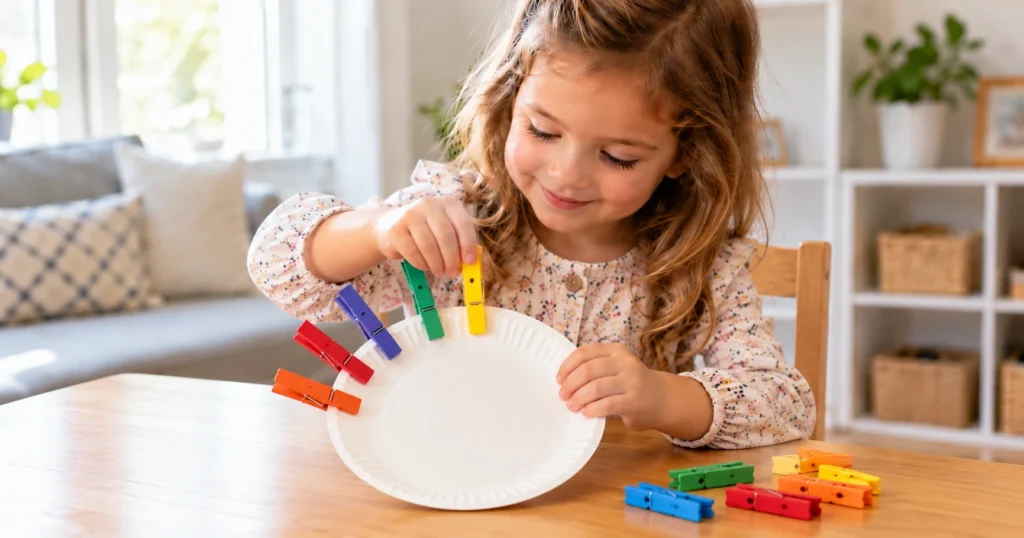
2. Clothespin Clip and Sort
Give your child a few clothespins and invite them to clip the clothespins around the edge of a piece of cardboard, a paper plate, or a small box.
Opening and closing the clothespins gives children practice using their fingers and hands in a controlled way.
You can keep the activity simple or add an extra challenge by asking your child to match colors, count the clothespins, or create a simple pattern.
You’ll need: Clothespins and a piece of cardboard, paper plate, or small box
3. Sticker Peel and Place
Give your child a sheet of stickers and a piece of paper with a few large circles, shapes, or simple targets drawn on it.
Invite them to peel the stickers and place them inside the shapes or on the marked spots.
Peeling and placing stickers gives children practice using their fingertips and coordinating their hand movements. Start with larger stickers and bigger targets, then use smaller ones if your child is comfortable.
You’ll need: Stickers, paper, and a crayon or marker
4. Play Dough Pinch, Roll, and Build
Give your child a small amount of play dough and invite them to pinch, roll, squeeze, flatten, and shape it with their hands.
They can make small balls, long snakes, simple shapes, or even try forming a few letters.
Play dough activities give children plenty of opportunities to use their fingers and hands in different ways while keeping the activity playful and open-ended.
You’ll need: Play dough and a clean work surface
5. Tear-and-Paste Paper Collage
Give your child a few pieces of scrap paper and invite them to tear the paper into smaller pieces using their fingers.
They can then glue the pieces onto a larger sheet of paper to create a simple collage.
Tearing, picking up, and placing the paper pieces gives children practice using their hands and fingers in different ways. For an easier version, use larger pieces of paper. For more challenge, draw a simple shape and invite your child to fill it with the torn pieces.
You’ll need: Scrap paper, child-safe glue, and a larger sheet of paper
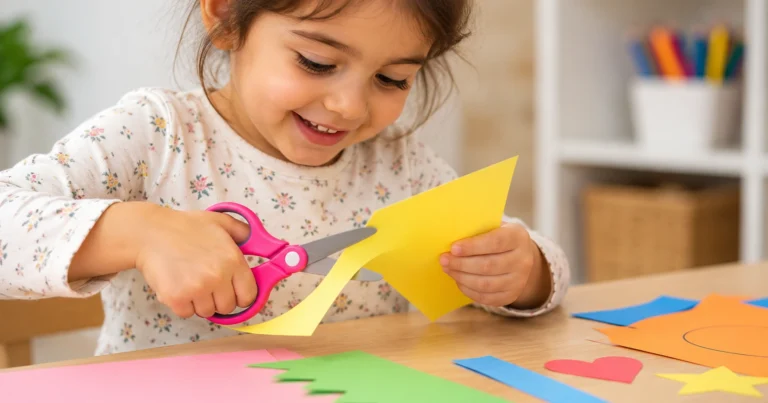
6. Cut Paper Strips
Cut a few strips of paper and draw short straight lines across them.
Invite your child to use child-safe scissors to make small snips along the lines.
Start with short, simple cuts. When your child is comfortable, you can try longer lines or gentle curves. Keep the activity short and supervise closely while scissors are being used.
You’ll need: Paper, a marker, and child-safe scissors
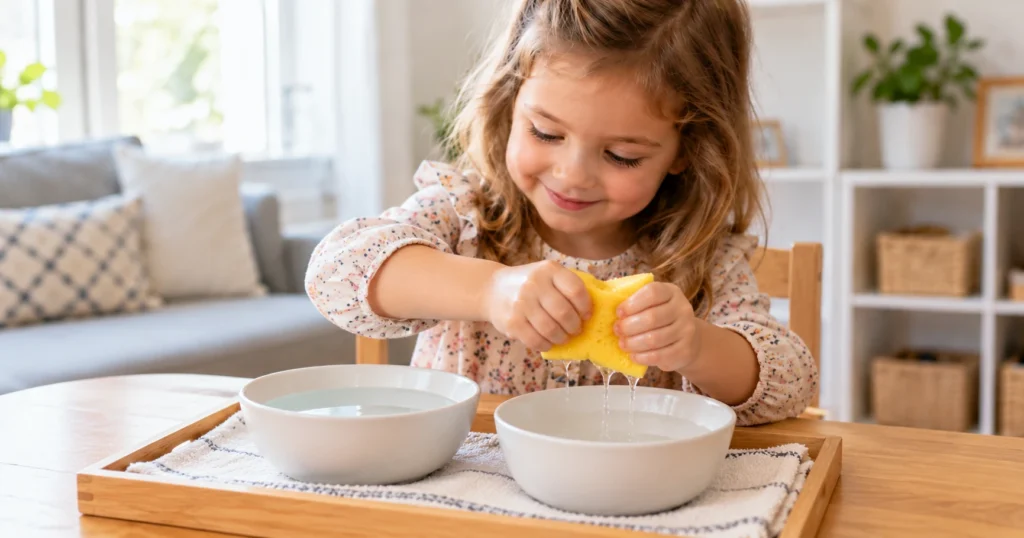
7. Sponge Squeeze Transfer
Place a small amount of water in one bowl and set an empty bowl beside it.
Give your child a clean sponge and invite them to soak it in the water, lift it, and squeeze the water into the empty bowl.
Squeezing the sponge gives children practice using their hands and fingers while also making the activity feel like simple play. Use only a small amount of water and place a towel or tray underneath to help with spills.
You’ll need: Two bowls, a clean sponge, a small amount of water, and a towel or tray
8. Open and Close Containers
Collect a few clean, lightweight containers with lids that are easy for your child to handle.
Invite your child to open the containers, close them again, and match each lid to the correct container.
Twisting, lifting, pressing, and fitting lids into place gives children practice using their hands and fingers during a simple everyday task. Avoid glass containers and choose items that are safe and comfortable for your child to use.
You’ll need: A few clean, child-manageable containers with matching lids
9. Build a Small Block Tower
Give your child a small set of age-appropriate blocks or building pieces and invite them to build a tower, wall, bridge, or simple structure.
Picking up, placing, stacking, and adjusting the pieces gives children practice using controlled hand and finger movements.
You can keep the activity open-ended or add a simple challenge, such as building a tower with a certain number of blocks or copying a basic pattern.
You’ll need: Age-appropriate blocks or building pieces
10. Pour Between Cups
Place a small amount of water in one lightweight cup and set an empty cup beside it.
Invite your child to slowly pour the water from one cup to the other.
Pouring gives children practice controlling their hand movements and adjusting how they hold and tilt the cup. Start with only a little water and place a towel or tray underneath to make spills easier to manage.
You’ll need: Two lightweight cups, a small amount of water, and a towel or tray
11. Help Set the Table
Invite your child to help with one simple part of setting the table, such as placing napkins, spoons, or lightweight cups.
Picking up, carrying, and placing these items gives children practice using their hands during a familiar everyday routine.
Keep the task small and manageable. You might ask your child to place one spoon at each seat or fold and set out a few napkins.
You’ll need: Napkins, spoons, lightweight cups, or other safe table items
12. Button, Zip, and Fasten
Give your child a jacket, cardigan, backpack, or another familiar item with buttons, a zipper, or simple fasteners.
Invite them to practice opening and closing one fastener at a time.
Buttoning, zipping, and fastening gives children practice using both hands together and making small, controlled finger movements. If the item is difficult to manage while wearing it, place it flat on a table first.
You’ll need: A jacket, cardigan, backpack, or another item with child-manageable fasteners
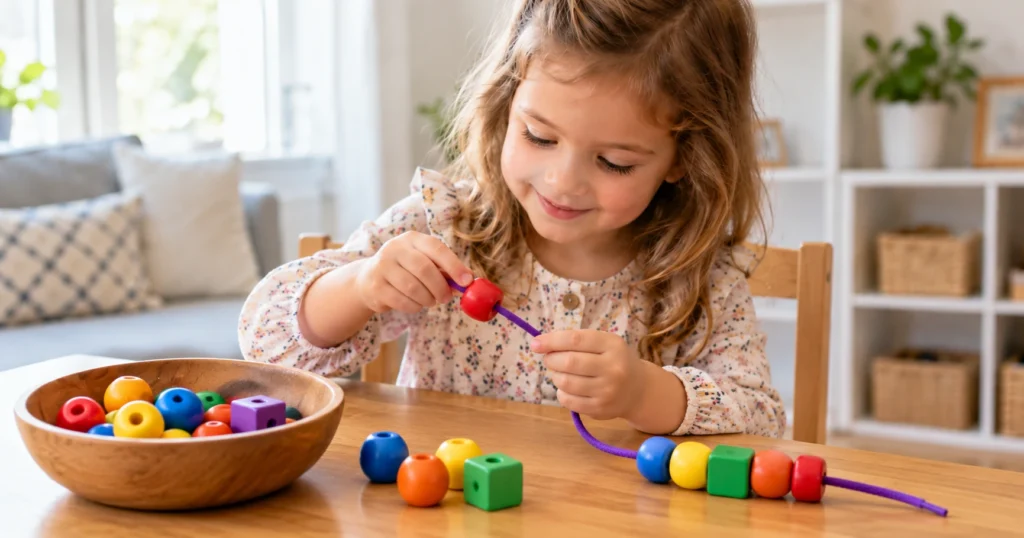
13. Thread Large Pieces
Give your child a few large beads or other age-appropriate threading pieces and a stiff lace, cord, or pipe cleaner.
Invite them to thread the pieces one at a time.
Threading gives children practice using their fingertips, coordinating both hands, and guiding small movements with care. Start with larger pieces that are easier to hold, and always supervise closely when small items are used.
You’ll need: Large beads or age-appropriate threading pieces and a stiff lace, cord, or pipe cleaner
14. Draw and Trace Simple Paths
Draw a few simple paths on a piece of paper, such as straight lines, curves, loops, or zigzags.
Invite your child to follow the paths with a crayon or marker.
Tracing simple paths gives children practice controlling their hand movements and following a visual guide. You can make it more playful by pretending the lines are roads and moving a small toy car along them before tracing.
You’ll need: Paper and a crayon or washable marker
15. Do a Simple Puzzle
Choose a simple, age-appropriate puzzle and invite your child to complete it at their own pace.
Picking up, turning, and fitting puzzle pieces into place gives children practice using their fingertips and coordinating what they see with how they move their hands.
For an easier version, choose a puzzle with fewer pieces or a familiar picture. As your child becomes more comfortable, you can gradually try puzzles with a little more detail.
You’ll need: An age-appropriate puzzle
How to Make Fine Motor Activities Easier or More Challenging
Every child will find different activities easier or harder, so it can help to adjust the activity rather than expecting the same level each time.
To make an activity easier, try using larger objects, fewer pieces, shorter tasks, or materials that are easier to hold. You can also demonstrate the activity once or let your child use both hands.
To make an activity more challenging, you can add sorting, counting, simple patterns, smaller targets, or slightly more precise movements.
The goal is to keep the activity manageable and enjoyable. If your child becomes frustrated or loses interest, it is fine to stop and try again another time.
Busy Parent Tips for Fine Motor Practice at Home
You do not need to plan several fine motor activities at once. Choosing one simple activity for a few minutes is often enough.
Keep a few reusable materials together, such as crayons, child-safe scissors, play dough, clothespins, or tongs, so they are easy to use when you have a little time.
You can also use everyday routines as opportunities for fine motor practice. Pouring, opening containers, fastening clothes, helping at the table, and other simple tasks can all give children chances to use their hands.
Most importantly, follow your child’s interest. If an activity is not working that day, it is fine to switch to something simpler or try again later.
Safety Tips for Fine Motor Activities
Choose materials that are appropriate for your child’s age and supervise activities as needed.
Use child-safe scissors for cutting activities, and stay nearby while your child is using them.
For water activities, use only a small amount of water and keep a towel or tray underneath.
If an activity includes small items such as beads or pom-poms, supervise closely and use larger alternatives when appropriate.
Avoid glass containers or anything sharp, breakable, or difficult for your child to handle safely.
Frequently Asked Questions
How often should kindergarten children do fine motor activities?
There is no strict schedule you need to follow. Short, regular opportunities during play and everyday routines can be enough. A few minutes of fine motor practice at a time can work well, especially when the activity feels enjoyable and manageable.
Do fine motor activities need worksheets?
No. Worksheets are only one option. Activities such as building, cutting, pouring, using play dough, opening containers, completing puzzles, and helping with simple household tasks can also give children opportunities to use their hands and fingers.
Which fine motor activities are useful before handwriting?
Activities such as drawing, tracing simple paths, using play dough, peeling stickers, building with blocks, completing puzzles, and practicing with child-safe scissors can all give children opportunities to use controlled hand and finger movements before or alongside early writing practice.
A Simple Place to Start
These fine motor activities for kindergarten can be a simple way to add more hands-on practice to your child’s day without creating a complicated routine.
Even a few relaxed minutes of pouring, building, cutting, squeezing, or picking up small objects can give your child opportunities to use their hands in purposeful ways.