
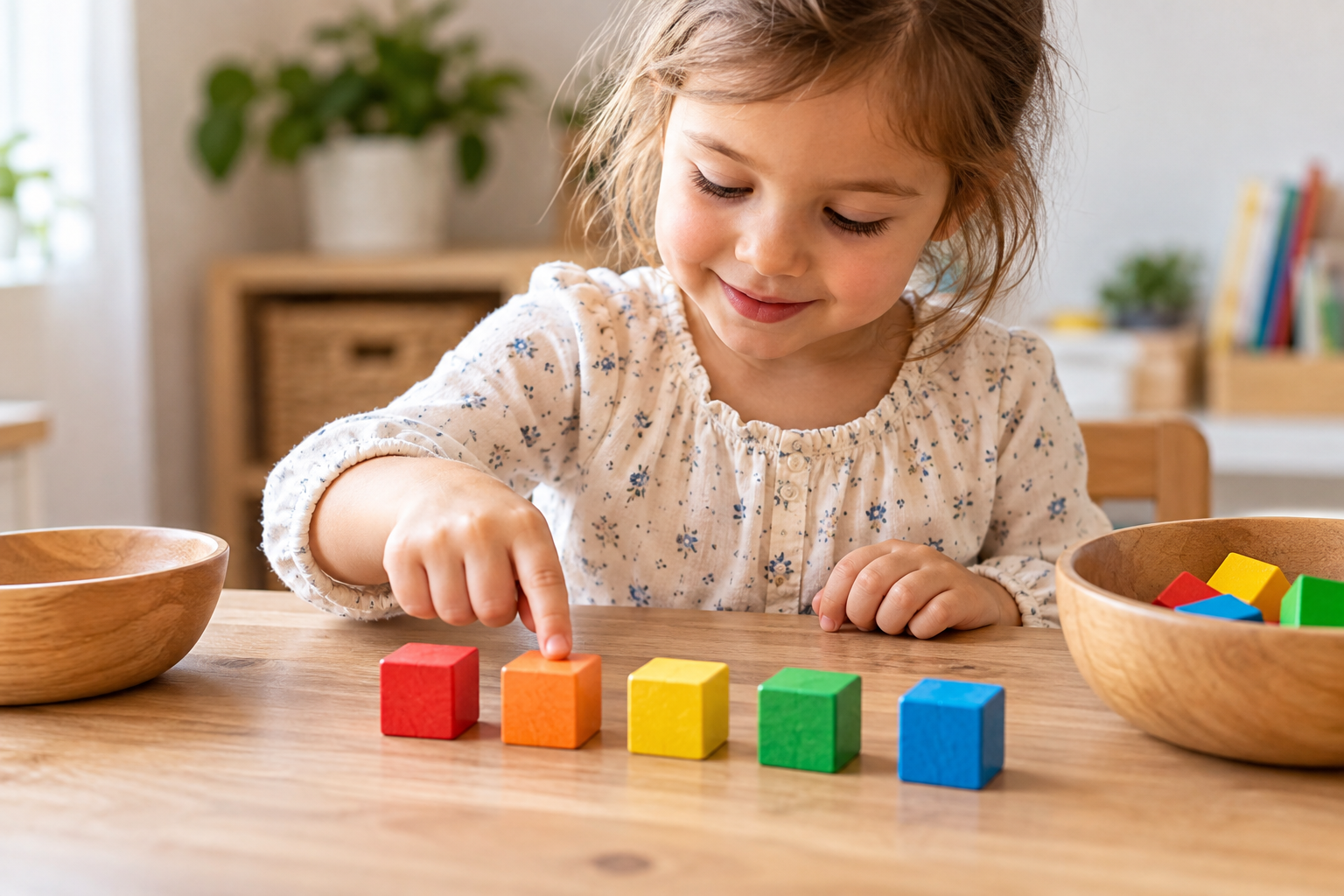
5-Minute Counting Activity Using Everyday Household Items
Some days, a simple math activity is all you need.
For this easy counting activity, you don’t need worksheets, special toys, or a long list of supplies. Just gather a few safe everyday items from around the house and invite your child to count them.
You might use blocks, large buttons, toy cars, spoons, or any other objects that are easy for your child to pick up and count.
It takes only a few minutes to set up and gives your child a simple opportunity to practice counting through everyday play.
Quick Activity Overview
Time: 5–10 minutes
Prep: Minimal
You’ll need: A small collection of safe household items
Focus: Counting and one-to-one correspondence
Best for: A quick math activity at home
What You’ll Need
Keep it simple. Choose a few items you already have at home:
- Blocks
- Toy cars
- Spoons
- Large buttons or other large craft items
- Small containers or bowls, if you’d like to sort the objects
You don’t need to use everything on this list. Pick one type of object—or mix a few together.
A quick safety note: Choose objects that are appropriate for your child’s age and avoid small items that could be a choking hazard. Supervise your child during the activity.
Set It Up in a Few Minutes
Choose a small group of objects and place them on a table or tray. Start with an amount that feels manageable for your child.
Invite your child to touch or move each object as they count it aloud. For example, they can move one spoon at a time from one side of the table to the other while saying, “one, two, three…”
There’s no need to rush or correct every mistake. If they lose track, simply start again together.
That’s it. No worksheets and no complicated setup.
Let Your Child Count
Let your child take the lead. They might touch each object as they count, move the objects one at a time, or line them up before they begin.
They may count the same object twice or skip one along the way. That’s okay. You can gently count together and try again.
Keep the activity relaxed. The goal isn’t to get every answer right—it’s to give your child a simple opportunity to explore counting with real objects.
What Is Your Child Practicing?
Counting real objects helps children connect number words with the objects in front of them.
As children touch or move one object for each number they say, they have opportunities to practice one-to-one correspondence—the idea that each object is counted once.
Over time, children also begin to understand that the last number they say tells how many objects are in the group.
You don’t need to explain these ideas as a lesson. Simply counting familiar objects together can give your child a playful way to explore early math at home.
Want to Make It Easier?
Start with just a few objects.
You can line them up or space them apart to make it easier for your child to keep track while counting.
If counting aloud feels tricky, count together. Point to or move each object as you say the numbers.
Keep it simple and stop when your child is ready to move on.
Ready for a Little More?
If your child enjoys the activity and wants to keep going, you can add a simple challenge.
Try adding a few more objects, sorting them into groups before counting, or comparing two groups to see which has more or fewer.
You don’t need to try everything at once.
Choose one small variation and keep it playful. A simple counting activity doesn’t need to turn into a long math lesson.
Busy Parent Tip
You don’t need to set up a special math activity every time.
Try counting things that are already part of your day: spoons while setting the table, toy cars during cleanup, or blocks while putting them away.
Using everyday moments keeps the activity simple and means there’s nothing extra to prepare.
A few minutes of counting can fit naturally into the day.
A Small Math Moment Is Enough
Math at home doesn’t have to mean worksheets or long lessons.
Sometimes it’s simply counting a few spoons, lining up toy cars, or moving blocks one at a time.
If your child counts for a few minutes and then moves on, that’s okay. There’s no need to turn a simple activity into something bigger.
Small everyday moments can be opportunities to explore math together.
Sources & Further Reading
Institute of Education Sciences (IES) — Teaching Math to Young Children